Case studies
Order Status App
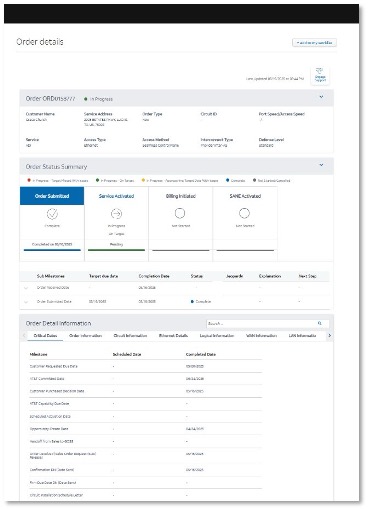
Led the design of a multi-persona Order Status App that replaced 4–6 hours of weekly manual tracking per customer with minute-level access to real-time order data. By co-creating with users across Customers, Sales, and Operations, we delivered instant adoption and a single source of truth spanning 400+ data fields.
Impact:4–6 hrs → minutes · 400+ data fields unified · Multi-persona adoption · Instant rollout
AI Experience Blueprint
The Direct Sales organization of a Fortune 100 company was underperforming, with no documented end-to-end process. I led a discovery and mapping initiative to expose hidden friction and misalignment, then overlaid process improvements and AI opportunities to define a clear, executable transformation strategy for sales performance.
Impact: Process visibility · Root-cause clarity · AI-ready foundation · Executive alignment

Marketecture
The purpose of the Marketecture was to align business and technology executives under a common, customer-led vision. It overlaid business functions, digital capabilities, AI components, and legacy systems across the end-to-end customer journey to create a holistic experience map—making gaps, overlaps, and critical interaction points visible and actionable.
Impact: Aligned executives around a single, experience-led blueprint that connected strategy, technology, and AI.

Change by Design
With six designers supporting an $80M program and 500 technologists, I led a design enablement strategy that balanced structure with energy—educating teams in Design Thinking while making it practical, approachable, and fun. The result was a shared mindset that transformed collaboration and delivery at scale.
Impact: Design at scale · Cultural adoption · Shared mindset · Sustainable change

Simplifying the Complex
The digital transformation journey for AT&T Business Operations focused on using design patterns and service design to simplify scale. I led the effort to standardize 24 personas and 120 job titles into 6 core personas and a unified service design map. This enabled a templated delivery approach that reduced development time by 60% while creating a consistent experience across 12 initiatives, impacting 18,000 employees.
Impact: Turned enterprise complexity into a scalable, repeatable operating model—faster to build, easier to use, and consistent at scale.
